7 science-based reasons to choose a ceramic dental implant.
Ceramic (zirconia, Y-TZP) dental implants have been a valuable alternative to metal (titanium) implants for decades. Today’s rough-surfaced ceramic implants are comparable to titanium in osseointegration, but offer several biological and aesthetic advantages.
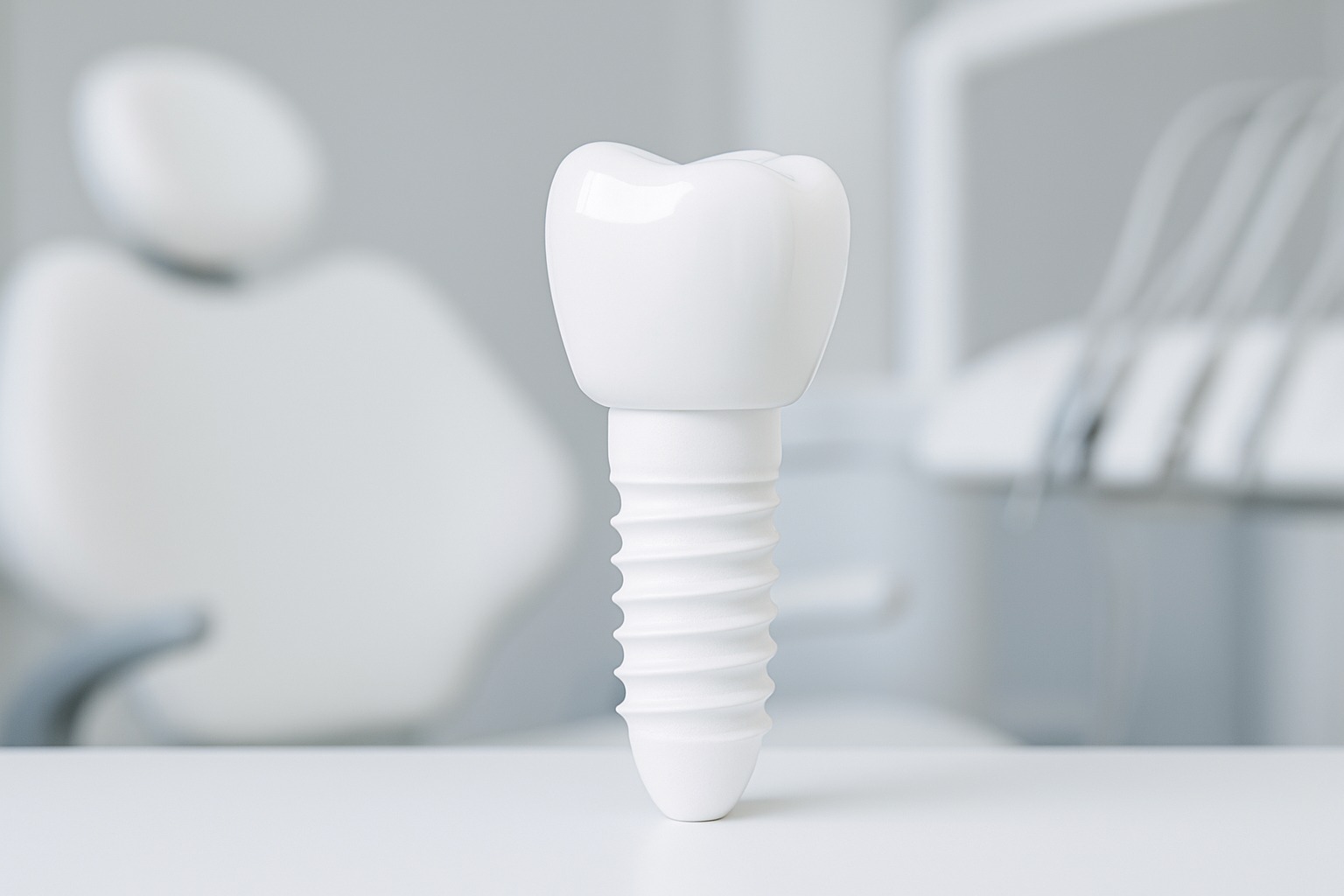
1. Metal-free and bioinert
Ceramics do not release ions or particles, thus they do not activate the immune system in the same way as titanium wear particles, which can trigger a chronic low-grade inflammatory response. Chen et al., 2023; Asa’ad et al., 2022 – more titanium particles have been found in peri-implant tissues that activate macrophages and the inflammasome. Spies et al., 2016 – zirconium oxide is electrically insulating and bioinert.
2. Neutral to electromagnetic waves
Titanium is a metal and can interact with electromagnetic fields, although no clinically significant effects have been shown. Zirconium oxide, however, is completely insulating, does not conduct electricity, and does not act as an antenna. Jain et al., 2019, Bioelectromagnetics. Computer models may indicate that titanium can affect local fields, but ceramics do not.
3. Less bacterial adhesion
Several studies have shown that fewer bacteria adhere to the surface of zirconium oxide than to titanium, which may reduce the risk of peri-implantitis. Kniha et al., 2021, J Periodont Res – meta-analysis, zirconia showed lower bacterial plaque formation. Chiou et al., 2023 – in vitro tests confirmed lower bacterial adhesion to the ceramic surface.
4. Aesthetic naturalness
The white substrate material provides a natural result in the aesthetic zone (the smile area) and avoids a gray shade in the case of thin gums, which can occur with titanium. Halim et al., 2022 – zirconia abutments provided a more natural gum color than titanium.
5. High mechanical strength
Modern Y-TZP implants are very durable and their compressive strength exceeds that of titanium alloys. Zhang & Lawn, 2018, Dental Materials – Y-TZP shows high compressive strength and fatigue resistance.
6. Equivalent osseointegration
Histological studies indicate that roughened ceramic implants achieve a bone-implant contact (BIC) level comparable to titanium. Thomé et al., 2021 (Neodent Zi, minipig model) – BIC 77.8% (ceramics) vs 80.7% (titanium), the difference is statistically insignificant. Mohseni et al., 2023 – clinical systematic review: ceramic survival over 95%.
7. Suitable for immediate implantation
Ceramic implants can be successfully used immediately after tooth extraction if adequate primary stability is achieved. Sailer et al., 2018, Clin Oral Impl Res – immediately placed zirconia implants showed good early results.
Summary
A ceramic implant is:
• body-pure and bioinert,
• neutral to electromagnetic waves,
• with less bacterial accumulation,
• aesthetically natural,
• mechanically strong,
• equivalent in osseointegration to titanium,
• and suitable for immediate implantation.
This makes ceramic implants a safe and aesthetic choice today from both health and beauty perspectives.
Dr. Meeme Luks - Holistic dentist
28 years of experience with ceramic implants