Gum disease vs collagen sources: does beef broth or marine collagen better support gum health?
Explore how homemade beef broth and highly bioavailable marine collagen affect MMPs and gum health. Pros, cons, practical tips.
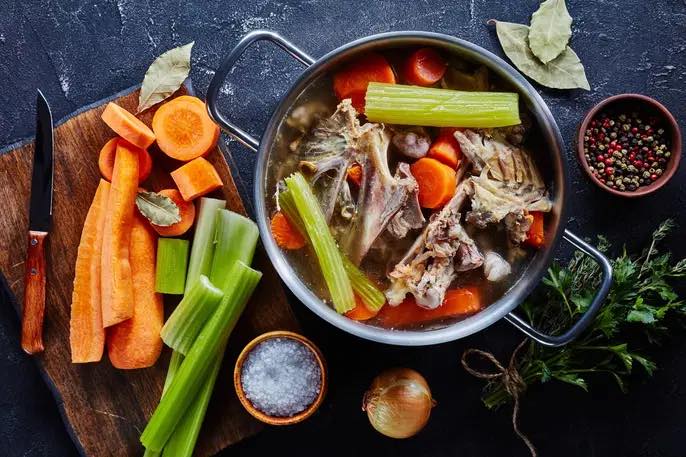
Gum disease, homemade broth and marine collagen.
In the case of gum diseases, the level of MMPs (read previous articles) is of significant importance.
Homemade beef broth vs. marine collagen: a comparison of MMP regulation and absorption.
Homemade beef broth from meat, tendons, and cartilage (so-called bone broth) has traditionally been valued as a food item often associated with health. Marine collagen is a processed supplement.
Composition comparison
Homemade beef broth
Collagen types: Contains mainly type I collagen (skin, tendons, bones)- Contains type II collagen (cartilage). Contains type IV collagen (membranes)- Collagen concentration: ~6-12 g/l depending on the preparation method
Other bioactive components:
- Glycosaminoglycans (especially chondroitin and hyaluronic acid)
- Amino acids (glycine, proline, alanine, glutamine)
- Minerals (calcium, magnesium, phosphorus, sulfur)
- Glycoproteins and growth factors- Various lipid types
Marine collagen Collagen types:-
Mainly type I collagen
- To a lesser extent type V collagen
- Collagen concentration: standardized, usually 90-95% purified product
Other bioactive components:
- Very few or completely absent (depending on the processing process)
- Processed marine collagen mainly consists of collagen peptides
- Some products are fortified with vitamins or minerals
Absorption and bioavailability
Homemade beef broth Absorption mechanism:
- Long cooking breaks down some collagen into gelatin and partly into peptides
- Contains both large molecules (gelatin) and small peptides
- The absorption of larger molecules is limited, but they may act as prebiotics in the colon
Bioavailability factors:
- Cooking time (6-48 h) significantly affects collagen peptide formation
- The use of an acidic environment (e.g. a bit of vinegar) increases collagen breakdown and bioavailability
- The food matrix supports absorption through synergistic components- Estimated bioavailability 30-60%, depending on the preparation method
Marine collagen Absorption mechanism:
- Pre-hydrolyzed to small peptides (molecular weight usually 0.3-8 kDa)
- Absorption mainly occurs through specific peptide transporters in the small intestine
- Small peptides are absorbed more quickly and effectively compared to large molecules
Bioavailability factors:
- Industrial hydrolysis optimized with specific molecular weight distribution
- Lack of food matrix effect (when consumed as a supplement)
- Lower molecular weight peptides (under 3 kDa) are absorbed significantly better
- Estimated bioavailability 70-90%
Effect on MMP regulation
Homemade beef broth
1. High content of proline and glycine:
- These amino acids are important in tissue repair and the synthesis of TIMPs (natural inhibitors of MMPs)
- Glycine reduces inflammation, which is a major cause of MMP overexpression
2. Growth factors and signaling molecules:
- Biologically active peptides derived from broth may modulate MMP gene expression
- TGF-β (transforming growth factor-beta) family molecules promote the expression of TIMP-1 and TIMP-2
3. Minerals and trace elements:
- Zinc, copper, and magnesium are cofactors for MMPs that influence their activity
- A balanced mineral composition supports normal MMP activity
4. Overall effect on MMP regulation:
- Moderate modulatory effect on MMPs
- Longer-term and more balanced impact on their activity
- Stronger anti-inflammatory component
Marine collagen 1. Specific bioactive peptides:
- Peptides released from marine collagen may directly bind to MMPs
- Some peptides inhibit specific types of MMPs (especially MMP-1, MMP-3, MMP-9)
2. Stimulation of fibroblasts: - Marine collagen stimulates fibroblasts to produce more TIMP-1 - Increases collagen synthesis activity, balancing the degradation caused by MMPs
3. Cell receptor signaling: - Marine collagen peptides may activate specific receptors that reduce MMP expression - Affect MAP kinase and NF-κB signaling pathways that regulate MMP gene expression
4. Overall effect on MMP regulation: - Stronger direct MMP inhibitory effect - Faster onset of action - More targeted towards specific MMPs
Practical comparison and recommendations Homemade beef broth
Strengths:
- A wholesome nutrient-rich food
- Contains several beneficial components in addition to collagen
- Long-standing usage supported by tradition
- As part of a whole food - additional matrix and synergies
- Flavor properties and culinary value
Weaknesses:
- Variable composition and quality depending on raw materials and preparation
- Lower and slower absorption
- Smaller specific MMP inhibitory effect
- Time-consuming preparation (6-48 hours)- Practically not standardizable
Practical recommendation: Regular consumption (2-3 times a week, 200-300 ml) as part of a balanced diet. Particularly beneficial in cases of inflammatory conditions and digestive issues.
Marine collagen
Strengths: High absorbability due to optimized molecular weight- Standardized composition and active ingredient content. Stronger and faster MMP inhibitory effect. Practical administration (powder, capsules)- Well-suited as additional supplementation
Weaknesses: Narrower profile of bioactive components. Lack of additional supportive effect from the food matrix. Higher cost- Isolated from its natural context
Practical recommendation: In the case of specific problems (e.g. periodontitis, skin aging, joint issues) at a dose of 5-10 g per day, as a course for 2-3 months.
Summary and optimal approach
1. Absorption: Marine collagen is absorbed significantly better due to its optimized molecular size (70-90% vs. 30-60% for beef broth).
2. MMP regulation: Marine collagen has a stronger and more specific direct MMP inhibitory effect, while beef broth has a broader, balancing impact through inflammation and tissue health.
3. Nutritional richness: Beef broth contains many additional nutrients and bioactive compounds that marine collagen does not contain.
The optimal approach would be a combination:
- Regular homemade quality beef broth as part of daily nutrition
- Marine collagen used additionally for the treatment of specific conditions or increased needs (e.g. rapid regulation of MMP activity in periodontitis or stimulating collagen synthesis)