Ceramic vs titanium implant – which one is more suitable for your body?
The installation of an implant is not just about restoring teeth, but also about the interaction between the body and the material. Its success depends not only on surgical precision but also on how the body interacts with the new material. While all implants used to be made of metal, more and more people and doctors today are discovering the advantages of ceramic implants – not only for aesthetics but primarily due to their biological compatibility.
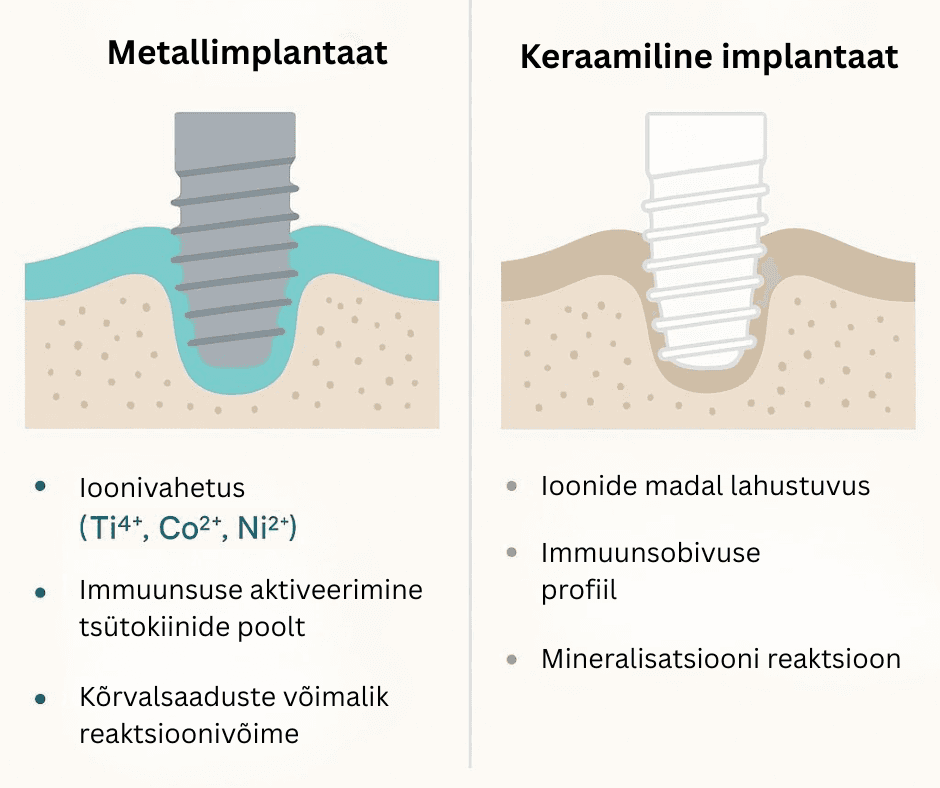
What happens in the body after implant placement?
Traditional titanium implants have proven their reliability for decades. However, studies have shown that metals are not completely passive – nano- and microparticles (Ti⁴⁺, Al³⁺, Ni²⁺) can detach from the titanium surface over time, which can activate the immune system and trigger chronic low-grade inflammation.
Ceramic implants, on the other hand, are chemically inert and bioactive – they do not release ions or change the body's pH. A natural hydroxyapatite layer forms on their surface, which is the same mineral substance that makes up our own bone.
This means that the body does not perceive the ceramic implant as a "foreign body", but embraces it as part of itself.
Less inflammation, better healing
Ceramic implant surfaces affect the immune system in a completely different way than metal surfaces.
Titanium can activate M1-type macrophages, which release inflammatory signaling molecules (IL-1β, TNF-α, IL-6).
Ceramic surfaces, on the other hand, promote the activity of M2-type macrophages, which produce IL-10 and TGF-β – these are calming and tissue-repairing cytokines.
The results are clinically visible:
less swelling and pain after placement,
faster bone healing (osseointegration),
and a more stable result for years.
Response of bone cells – level of osteoblasts and osteocytes
In vitro and animal studies have shown that the activity of osteoblasts is 20–30% higher on ceramic implants than on titanium.
This means that bone attaches faster and stronger.
Osteocytes, or bone "guardian cells", bond directly with the ceramic surface – a natural chemical bond occurs, not just mechanical contact.
As a result, the bone-implant interface is denser, with fewer micro-cracks, reducing the risk of inflammation and bone loss.
Redox balance and galvanic potential
If there are multiple different metal materials in the mouth (e.g., crowns, bridges, implants), a microgalvanic current may occur between them{