Micro leaks from metal implants and why ceramics are a cleaner alternative
In the case of titanium implants, it has been observed that although they integrate very well with the bone and remain stable, there is a continuous microscopic search for balance between them and the body. This process can be referred to as micro-leakage – the ongoing exchange and interaction between the metal and the surrounding tissue.
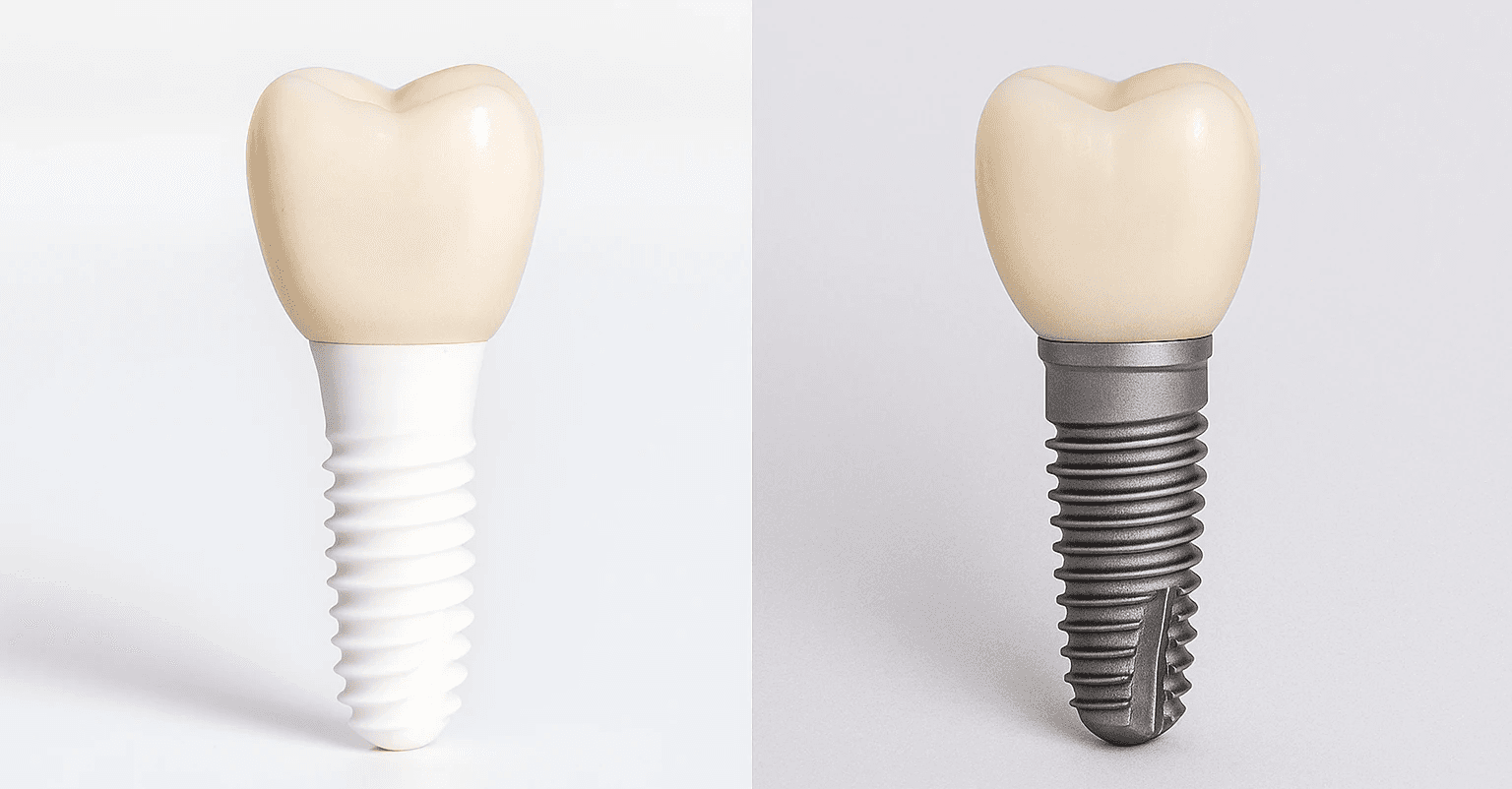
1. Tribocorrosion and Particle Release
• Titanium is covered with an oxidation layer (TiO₂), which ensures its biocompatibility.
• In the variable environment of the mouth (pH fluctuations, salivary proteins, bacteria, mechanical load), this layer may periodically get damaged.
• The result is the release of titanium particles and ions, which have been found in both bone and lymph nodes.
Asa’ad et al., 2022; Chen et al., 2023
2. The Body's Constant "Balance-Seeking"
• The body responds to titanium particles through macrophages and inflammatory mediators (IL-1β, TNF-α, IL-6).
• This may remain subclinical, meaning unnoticed, but the organism continuously expends energy to neutralize them.
• In some patients, this may lead to the eventual loss of late stability, even without the classic signs of peri-implantitis.
3. Late Implant Losses Without Inflammation
Cases have been described where an implant functions without problems for years, but becomes mobile after 5–10 years:
• no bone loss is visible,
• there are no signs of inflammation,
• but the connection between the implant and bone has been lost.
This is associated with continuous microleakage and changes in the oxidation layer, leading to the gradual weakening of bone contact.
Mardas et al., 2013, Clin Oral Impl Res – late failures may occur without infection, rather due to biomechanical and material-related factors.
4. Difference of Ceramic Implant
Zirconium oxide (Y-TZP) is an electrically and chemically inert material:
• does not release ions or particles,
• does not change its surface layer,
• is EMF-neutral – does not conduct electricity nor act as an antenna,
• histologically shows stable bone-implant contact even after years.
Thomé et al., 2021; Spies et al., 2016
5. What Does This Mean for the Patient?
“The metal implant functions in the mouth like a living system – it continuously tries to maintain balance between the body and the environment. In the process, microscopic metal particles may be released, which the body must neutralize. Most of the time, this does not cause problems, but in some people, it may lead to later troubles or implant loss.
The ceramic implant is different – it is bioinert and completely stable, does not interact chemically or electrically with the body. This means a cleaner, calmer, and more long-term safe solution.”
Summary
• Titanium implant – very reliable, but in some patients, microleakage may develop long-term: particle release, immune response, late loss of stability.
• Ceramic implant – bioinert, does not release ions or particles, EMF-neutral, aesthetic, and comparable in osseointegration to titanium.
Therefore, ceramics are a preferred solution for patients seeking a body-friendly and permanently calm implant solution.
Author: Dr. Meeme Luks, implantologist since 1997